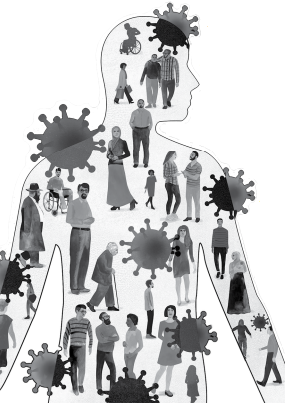
A MICROBE PROVED THAT INDIVIDUALISM IS A MYTH
Humans evolved to be interdependent, not self-sufficient
Anthropologists have long recognized that exceptionally high degrees of sociality, cooperation and communal care are hallmarks of humankind, traits that separate us from our closest living relatives, the chimpanzees and bonobos. This interdependence has been key to our success as a species. Viewed this way, we humans have an evolutionary mandate to be generous and take care of one another. But unlike early humans, who lived in comparatively small groups, we cannot just rely on our immediate family and friends for support. We must invest in national policies of communal care – policies that facilitate access to resources for people who need help. […]
In a sense, the entanglement of our everyday lives made us all the more vulnerable to an airborne virus that demanded social isolation […] The new COVID normal, with its mask wearing, social distancing, lockdowns and closed schools, compelled us to abandon our most basic instincts and turn away from our closest friends and family. It rent the social fabric on which we all rely. […]
This pandemic exposed the fragility and faults in each layer of our lives – from our innermost circle of family and friends to the nation state at the periphery – and the differential risk experienced by any individual’s core community. Communities that were already heavily invested in social safety nets with measures such as paid sick leave were able to lower COVID rates. Those invested in the ideology of self-sufficiency and individualism prolonged suffering and loss of life. […]
A microbe revealed the lie of rugged individualism. We are not self-sufficient and independent; we never have been. Our fates are bound together. Taking care of others is taking care of ourselves. […]
The emergence of each new COVID variant is an opportunity to reflect on what worked and what did not with the last one. […] Committing ourselves to upholding our evolutionary mandate to help one another – not just the people we see every day but everyone, everywhere – is the only thing that will save us.
By Robin G. Nelson, Scientific American, March 2022, pp.32,33
The text stresses the need for communal care policies because